Concrete or Asphalt: The Short Answer
Both are proven driveway materials, and the right choice usually comes down to budget, how long you plan to own the property, and climate. Asphalt generally costs less up front and handles freeze-thaw winters — common across South Jersey, Philadelphia, Delaware, and Maryland — more gracefully because it flexes instead of cracking. Concrete costs more initially but typically lasts longer and needs less routine maintenance. Neither is objectively “better” — they’re built for different priorities.
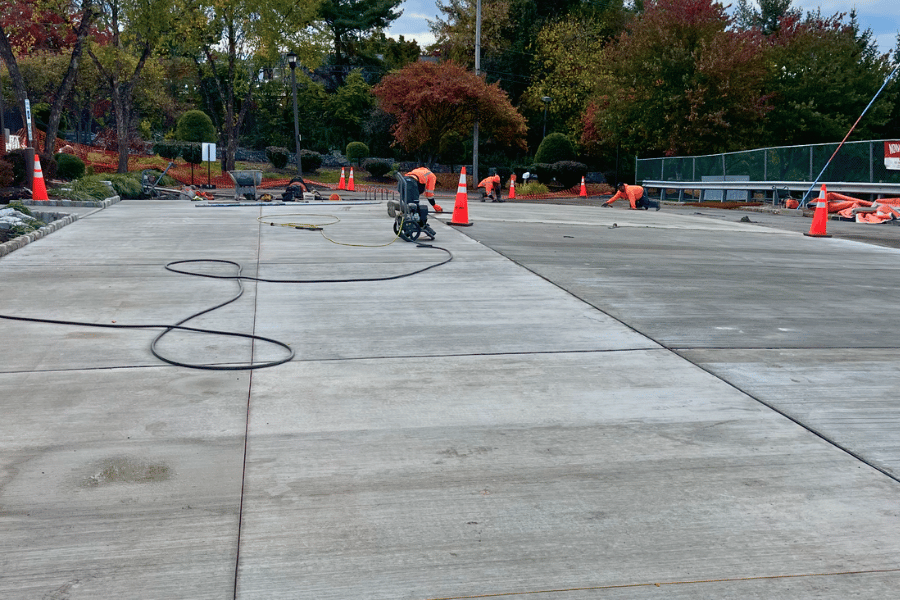
Side-by-Side Comparison
| Asphalt | Concrete | |
|---|---|---|
| Typical installed cost | Generally lower | Generally higher |
| Typical lifespan | 20 – 30 years | 30+ years |
| Freeze-thaw performance | Flexes with temperature changes, resists cracking | Rigid — more prone to cracking without proper joints and base |
| Routine maintenance | Sealcoating every 2–3 years | Occasional sealing, crack/joint maintenance |
| Repair approach | Patch and re-seal — repairs blend in well | Patch or replace slab sections — repairs are more visible |
| Installation time | Faster; usable in 2–3 days | Slower; needs 5–7 days to cure before use |
| Appearance | Classic black, uniform finish | More design flexibility (stamped, colored, exposed aggregate) |
| Best climate fit | Cold climates with freeze-thaw cycles | Warmer, more stable climates (though widely used everywhere) |
Why Climate Matters More Than People Expect
In our service area — South Jersey, Greater Philadelphia, Delaware, and Cecil County, Maryland — winters bring repeated freeze-thaw cycles that stress any pavement. Water gets into small cracks, freezes, expands, and widens the crack. Asphalt’s flexibility lets it absorb some of that movement without cracking as readily; concrete’s rigidity means a well-built base and properly placed control joints matter even more to prevent cracking over time. Neither material is immune to winter damage — asphalt still needs sealcoating and crack sealing, and concrete still needs proper joints and drainage — but this is a real factor worth weighing for a driveway you want to last decades in this climate.
When Asphalt Makes More Sense
- You want the lower up-front cost
- You want the driveway usable again within a few days
- You’re in a colder climate with regular freeze-thaw cycles
- You’re comfortable with periodic sealcoating as routine maintenance
Asphalt paving is Asphaltech’s core specialty — see our asphalt driveway cost guide for a full pricing breakdown.
When Concrete Makes More Sense
- You want a longer lifespan with less frequent resurfacing
- You want design flexibility — stamped patterns, color, exposed aggregate, or a decorative finish
- You’re planning to stay in the home long-term and want to minimize ongoing maintenance
- You want a lighter-colored surface that stays cooler in direct sun
Asphaltech also handles concrete installation and decorative concrete for driveways, patios, and walkways.
A Middle Ground: Decorative Concrete
If you like concrete’s durability but want more visual character than a plain gray slab, stamped or colored concrete gives you a driveway that mimics brick, stone, or pavers at a lower cost than the real material — worth a look if appearance is a bigger factor than pure budget.
Frequently Asked Questions
Which lasts longer, concrete or asphalt? Concrete typically lasts longer overall (30+ years) with less frequent resurfacing, while a well-maintained asphalt driveway commonly lasts 20-30 years with sealcoating every 2-3 years.
Which is cheaper to repair? Asphalt repairs (patching, crack sealing, resealing) tend to blend into the surrounding surface better and cost less per repair than concrete slab repairs, which often require replacing an entire section.
Can I switch from one to the other later? Yes — an existing asphalt or concrete driveway can be removed and replaced with the other material, though this is a full replacement project rather than a resurfacing job.
Does one add more resale value than the other? Both are considered standard, expected driveway materials in most markets; a well-maintained driveway of either type supports curb appeal, while a cracked or neglected one of either type hurts it.
Still deciding? Asphaltech installs both materials across New Jersey, Pennsylvania, Delaware, and Maryland, so we’re not steering you toward one to make a sale — request a free estimate or call (856) 454-7770 and we’ll walk through what actually fits your budget, timeline, and property.