What Is ADA Parking Lot Compliance?
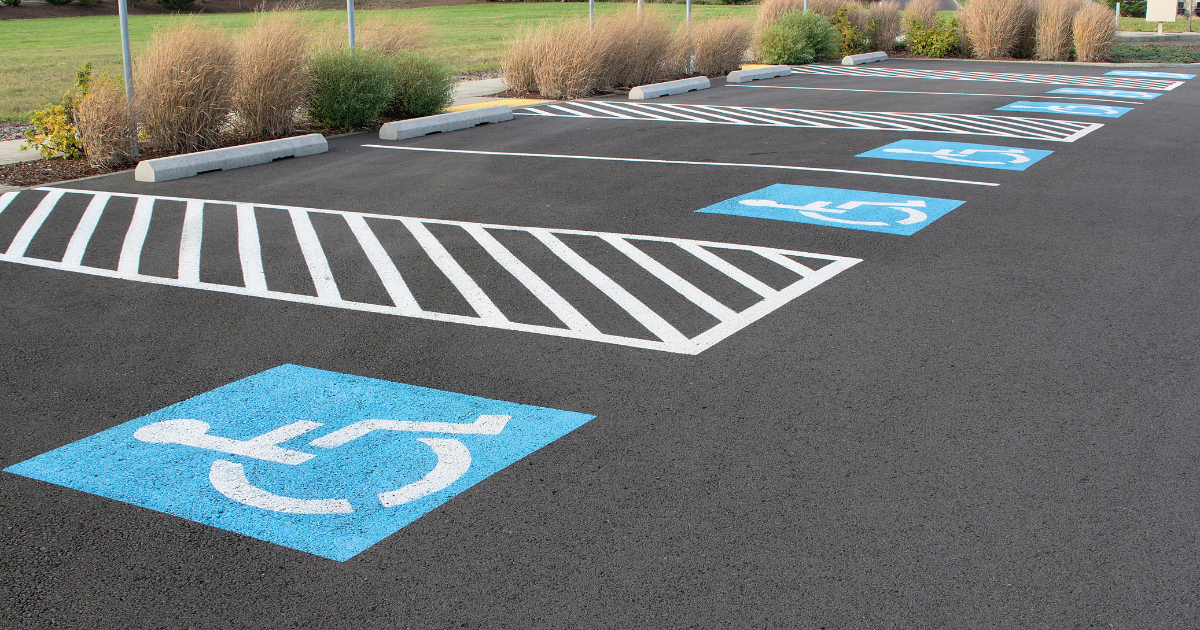
ADA parking lot compliance means a commercial or public parking lot meets the accessibility standards set by the Americans with Disabilities Act (ADA), a federal civil rights law passed in 1990. In practice, that means the lot has the right number of accessible spaces for its size, those spaces and their access aisles are the correct dimensions, a portion are van-accessible, everything is marked with the International Symbol of Accessibility, and there’s an unobstructed accessible route from the spaces to the building entrance. Parking lots are usually a visitor’s first point of contact with a business, so the ADA treats them as a priority accessibility feature — not an afterthought.
How Many Accessible Parking Spaces Does My Lot Need?
The 2010 ADA Standards for Accessible Design (Table 208.2) set the minimum number of accessible spaces based on the total number of spaces in the lot:
| Total Parking Spaces in Lot | Minimum Accessible Spaces Required |
|---|---|
| 1–25 | 1 |
| 26–50 | 2 |
| 51–75 | 3 |
| 76–100 | 4 |
| 101–150 | 5 |
| 151–200 | 6 |
| 201–300 | 7 |
| 301–400 | 8 |
| 401–500 | 9 |
| 501–1,000 | 2% of total spaces |
| 1,001+ | 20, plus 1 for every 100 spaces over 1,000 |
At least 1 in every 6 accessible spaces (minimum of one) must be van-accessible. So a 100-space lot needs 4 accessible spaces total, and at least 1 of those 4 must be van-accessible.
Designing an ADA Compliant Parking Lot
Designing an ADA compliant parking lot requires careful consideration of various factors, such as the size and layout of the parking lot, the number of parking spaces required, and the accessibility features needed to accommodate people with disabilities. Here are some important guidelines to keep in mind when designing an ADA compliant parking lot:
-
Number of Accessible Parking Spaces: The number of accessible parking spaces required in a parking lot is based on the total number of parking spaces in the lot. The ADA requires that at least one accessible parking space be provided for every 25 parking spaces, or fraction thereof. For example, if a parking lot has 100 spaces, it must have at least four accessible parking spaces.
-
Accessible Parking Space Dimensions: Accessible parking spaces must be designed to accommodate people with disabilities, including those who use wheelchairs or other mobility devices. The minimum size for an accessible parking space is 96 inches wide, with an adjacent access aisle that is at least 60 inches wide. The access aisle provides space for individuals to transfer from their vehicle to a mobility device, such as a wheelchair. The number of accessible parking spaces required is determined by the total number of parking spaces in the lot. For example, if a parking lot has 26 to 50 parking spaces, it must have at least two accessible parking spaces. If the lot has 51 to 75 parking spaces, it must have at least three accessible parking spaces, and so on.
-
Van-Accessible Parking Spaces: In addition to standard accessible parking spaces, parking lots must also provide van-accessible parking spaces. Van-accessible spaces must have a minimum width of 96 inches and an adjacent access aisle that is at least 96 inches wide. These Van-accessible spaces must be provided in parking lots for people with disabilities who use vans with wheelchair lifts or ramps.
-
Accessible Parking Space Markings: Accessible parking spaces and access aisles must be clearly marked with the International Symbol of Accessibility. The markings must be located on the ground in a visible location and must be maintained to ensure visibility.
-
Accessible Routes: Accessible routes must be provided from accessible parking spaces to the entrance of the building or facility. The route must be at least 36 inches wide and must be free of obstructions, such as curbs or steps. In addition, accessible routes must have a firm, stable, and slip-resistant surface, and must be free of any changes in level greater than ¼ inch. Accessible routes must also be clearly marked with the international symbol of accessibility.
-
Curb Ramps: Curb ramps must be provided at all locations where a pedestrian walkway crosses a curb or other barrier. The ramp must be at least 36 inches wide and have a slope of no more than 1:12.
-
Signage: Signage must be provided to indicate the location of accessible parking spaces and accessible routes. The signs must be placed at a height of 60 inches above the ground and must be clearly visible.
-
Parking Lot Lighting: Parking lots must be well-lit to ensure that people with disabilities can safely navigate the parking lot. The lighting must be sufficient to provide a minimum of 1 foot-candle of illumination at the ground level.
An accessible parking lot is essential for ensuring that individuals with disabilities have equal access to public spaces. Designing an ADA compliant parking lot and maintaining and enforcing its accessibility features is critical to ensuring that it remains usable for all. Property owners and businesses must take the necessary steps to create and maintain an accessible parking lot, including providing adequate parking spaces, access aisles, and curb ramps, as well as properly maintaining signage and markings and enforcing their use. By doing so, they can create a welcoming and inclusive environment for all individuals. To read more about ADA compliance, check out the Accessible Parking Spaces page on the ADA.gov site.
How Often Should ADA Parking Lot Striping Be Repainted?
Even a correctly designed ADA layout falls out of compliance over time — paint and thermoplastic markings fade with UV exposure, snowplowing, and everyday traffic. As a general guideline, most commercial lots need accessible markings refreshed every 1 to 2 years for painted striping, or 3 to 5 years for thermoplastic, but high-traffic lots and lots in harsher winter climates (like South Jersey, Philadelphia, and Delaware) often need it sooner. If the access aisle hatching, the International Symbol of Accessibility, or the van-accessible signage is hard to see from a moving vehicle, it’s time to restripe — faded ADA markings are one of the most common compliance complaints property managers face.
What Happens If a Parking Lot Isn’t ADA Compliant?
Non-compliant parking lots expose property owners to real risk: the Department of Justice can pursue civil penalties for ADA Title III violations, and non-compliant lots are a frequent target of private lawsuits and demand letters from advocacy groups and individual plaintiffs. Beyond the legal exposure, a lot with too few accessible spaces, missing van-accessible spots, or faded markings is simply harder — or unsafe — for disabled visitors, employees, and customers to use. Regular striping maintenance and periodic ADA audits are the most cost-effective way to avoid both outcomes.
Frequently Asked Questions
What is ADA parking? ADA parking refers to the accessible parking spaces, access aisles, and signage that federal law (the Americans with Disabilities Act) requires at parking lots serving businesses and public facilities, sized and marked according to the 2010 ADA Standards for Accessible Design.
What makes a parking lot ADA compliant? A lot is ADA compliant when it has the required number of accessible spaces for its total size (see the table above), correctly dimensioned access aisles, the required share of van-accessible spaces, proper signage and pavement markings, and an unobstructed accessible route to the building entrance.
Who is responsible for ADA parking lot compliance? The property owner or business operating the facility is generally responsible for maintaining ADA-compliant parking, including keeping striping and signage visible and up to code.
Does a small business parking lot need to be ADA compliant? Yes. Any parking lot serving a place of public accommodation is subject to ADA requirements — even a lot with only a handful of spaces must provide at least one accessible space.
If you need help designing, restriping, or maintaining an ADA compliant parking lot in New Jersey, Pennsylvania, Delaware, or Maryland, Asphaltech Pavement Solutions can help. Our line striping crews handle ADA-compliant layouts, van-accessible space markings, and signage for commercial properties across the region — see our parking lot striping near me page for local service, or request a free estimate to get your lot back in compliance.
** DISCLAIMER: This article is for informational purposes only and is not intended to provide legal advice. You should consult an attorney to obtain advice with respect to any particular issue or problem as well as reference the ADA.gov website.